
Natural Products Sourcebook
Ward 142
Type:
MARROW SMEAR
Description:
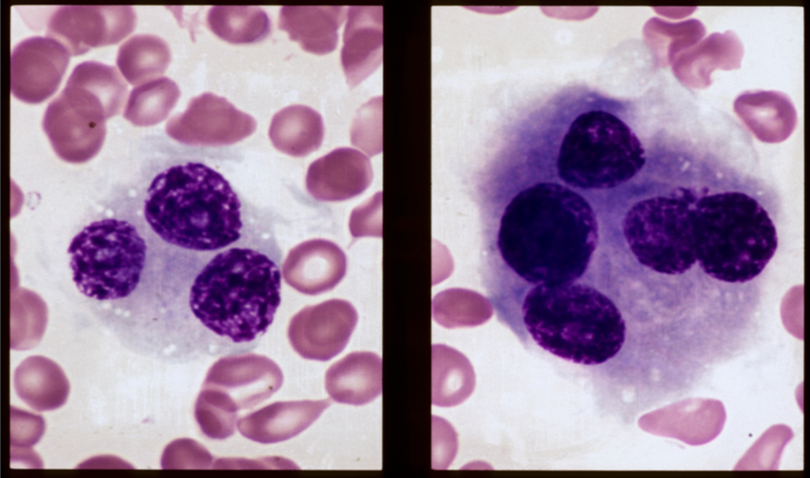
Further examples of multinucleated myeloma cells are shown. Cells such as these are rarely observed in reactive states. They are therefore fairly reliable indicators of neoplasia. See comment.
Comment:
The descriptor used in this case and in cases to follow i.e. ‘pleomorphic’, serves two purposes: 1) it helps define a group of myelomas with a prognosis intermediate between well-differentiated myelomas and high-grade anaplastic or plasmablastic myelomas , 2) it helps promote awareness of a heterogenous entity which could mimic a variety of unrelated disorders such as metastatic carcinomas, cleaved cell lymphomas or even myelomonocytic leukemias (Zuckerberg L R, Ferry J A, Conlon M and Harris N L, Am J Clin Pathol 1990;93:657-661).
The latter purpose (2) is particularly cogent in some morphologic variants of the disease considered under the rubric of ‘pleomorphic’, especially myelomas described as multilobated, cleaved or monocytoid.
Another important aspect of pleomorphic myelomas is that collectively they are considered aggressive and associated with a poor prognosis. Even with this rating, they are not quite as ominous as anaplastic or plasmablastic myelomas.
Slide Image:
Case Series:
PLEOMORPHIC MYELOMA
Series No.:
CASE1
Case No.:
5
- Log in to post comments